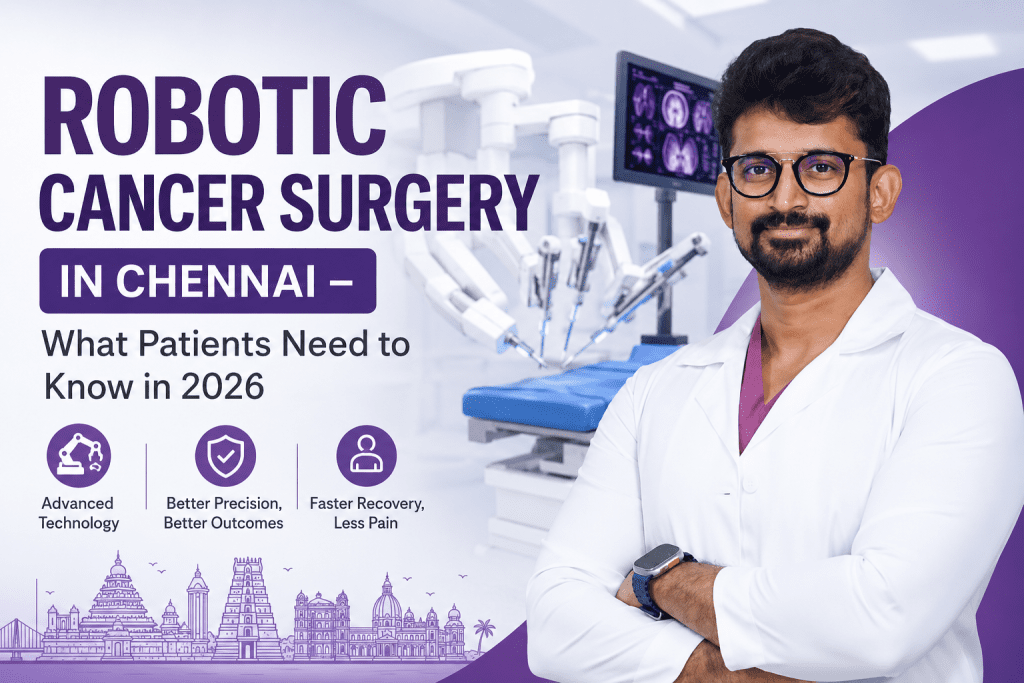
What Is Robotic Cancer Surgery?
Robotic cancer surgery is one of the most significant advances in modern oncology. Using the da Vinci robotic surgical system, a surgeon controls precise robotic arms through a console — allowing movements more accurate than the human hand in spaces too small for conventional instruments.
In Chennai, Dr. Srikarthik Voleti is among the pioneering surgeons offering robotic cancer surgery — a capability he developed through formal fellowships at NYU Langone Health, New York (Robotic Thoracic Oncology) and Aster International Institute of Oncology & National Cancer Centre, Singapore (Robotic & Minimal Access Surgery).
How Robotic Surgery Works
- The surgeon sits at a console a few feet from the patient.
- The console provides a magnified, 3D high-definition view of the surgical site.
- Hand and finger movements are translated into precise robotic arm movements.
- Tremor-filtering technology ensures sub-millimeter accuracy.
- The patient has 3–5 small incisions (usually 8–12mm each) instead of one large open wound.
This minimally invasive approach is particularly valuable in cancer surgery, where precision matters enormously — removing all cancer while sparing healthy tissue and vital structures.
Which Cancers Can Be Treated with Robotic Surgery in Chennai?
Gastrointestinal Cancers
- Rectal cancer – Robotic low anterior resection or APR for rectal tumors
- Colon cancer – Right hemicolectomy, left hemicolectomy, sigmoidectomy
- Stomach cancer – Total or subtotal robotic gastrectomy with D2 lymphadenectomy
- Esophageal cancer – Minimally invasive esophagectomy
Thoracic (Chest) Cancers
- Lung cancer – Robotic VATS lobectomy, segmentectomy
- Mediastinal tumours – Thymectomy and mediastinal tumor resection
Gynecological Cancers
- Uterine cancer – Robotic hysterectomy with lymph node dissection
- Ovarian and cervical cancers – Robotic debulking and staging surgery
Urological Cancers
- Kidney cancer – Robotic partial or radical nephrectomy
- Bladder cancer – Robotic cystectomy
Thyroid & Endocrine Surgery
- Thyroid cancer – Robotic thyroidectomy with lymph node dissection when indicated
- Benign thyroid nodules and goiter – Robotic hemithyroidectomy or total thyroidectomy
Robotic Surgery vs Open Surgery vs Laparoscopy – A Comparison
| Feature | Open Surgery | Laparoscopy | Robotic Surgery |
|---|---|---|---|
| Incision Size | Large (15–30cm) | Small (3–5 ports) | Small (3–5 ports) |
| Precision | Standard | Good | Highest |
| 3D Visualization | No | 2D | Yes (3D HD) |
| Tremor Control | No | No | Yes |
| Recovery Time | 7–14 days | 3–5 days | 2–4 days |
| Complex Anatomy | Yes | Limited | Yes |
| Best For | Large/Complex Tumors | Routine Cases | Complex Cancer Surgeries |
Benefits of Robotic Cancer Surgery
- ✅ Smaller incisions – Minimal scarring and reduced wound complications
- ✅ Less blood loss – Often no need for transfusion
- ✅ Less post-operative pain – Reduced need for strong pain medications
- ✅ Faster discharge – Many patients go home earlier than with open surgery
- ✅ Quicker return to normal activity
- ✅ Lower infection risk
- ✅ Better visualization for the surgeon
- ✅ Equivalent cancer outcomes with excellent oncological results
HIPEC – Advanced Robotic Peritoneal Surgery
For cancers that have spread to the lining of the abdominal cavity (peritoneum), Dr. Voleti offers Cytoreductive Surgery (CRS) with HIPEC (Heated Intraperitoneal Chemotherapy).
- Removal of all visible tumor deposits
- Heated chemotherapy circulated within the abdomen
- Targets microscopic cancer cells
- May offer long-term disease control or cure in selected patients
Dr. Voleti won the Best Poster Award at SISSO, Seoul, South Korea for his research on Fluorescence-Guided Robotic Total Peritonectomy and HIPEC.
Recovery After Robotic Cancer Surgery
- Day 1–2: Hospital monitoring and early walking
- Day 2–4: Most patients discharged home
- Week 1–2: Follow-up and light activities
- Week 3–4: Return to light work
- Week 6+: Full recovery
Is Robotic Cancer Surgery Covered by Insurance in India?
Yes. Most major health insurance policies in India now cover robotic surgery. Patients should verify specific policy coverage details before treatment.
Why Choose Dr. Srikarthik Voleti for Robotic Cancer Surgery in Chennai?
- Two dedicated robotic oncology fellowships
- Training at NYU Langone Health, USA
- Expertise across multiple cancer specialties
- Award-winning robotic HIPEC research
- Patient-focused care and detailed counseling
- Dedicated robotic surgery infrastructure
Book a Robotic Cancer Surgery Consultation in Chennai
📞 +91-89391 02777
Kauvery Hospital, Kovilambakkam: Mon–Sat 9am–5pm
Ojas Clinic, Royapettah: Mon–Sat 6pm–8pm
FAQ – Robotic Cancer Surgery in Chennai
Patient Reviews & Clinic Information
Patients can explore both Dr. Srikarthik Voleti's professional profile and Ojas Cancer Care's clinic profile on Google.