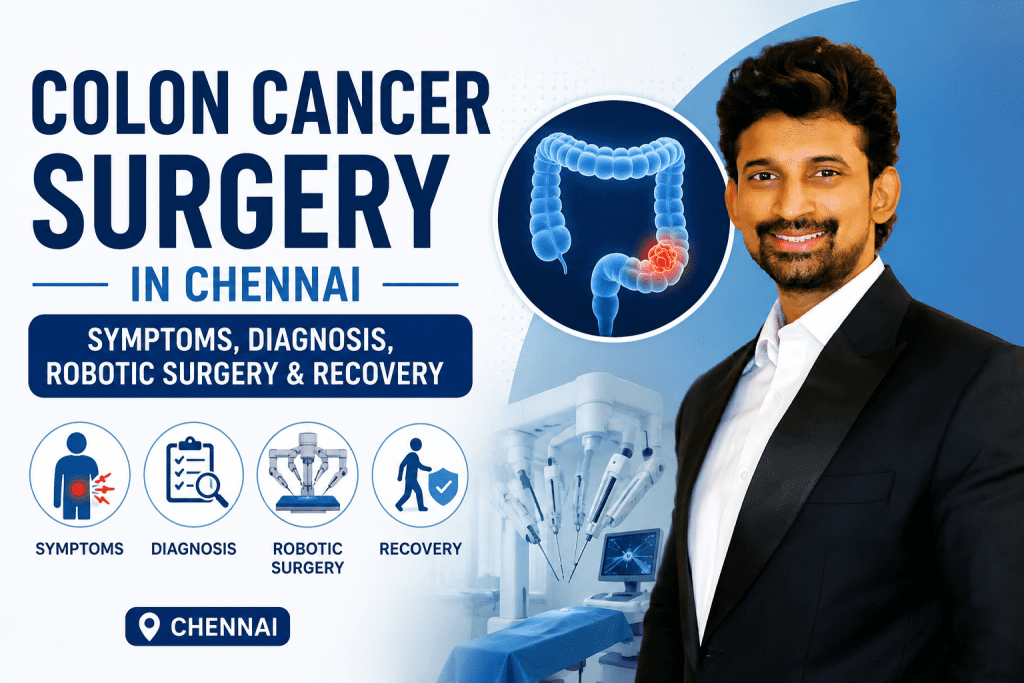
Colon Cancer in Chennai – What You Need to Know in 2026
Colorectal cancer (cancer of the colon or rectum) is the third most common cancer in India and is rising rapidly due to changing dietary habits, sedentary lifestyles, and increasing consumption of processed foods. In Chennai, colorectal cancers are increasingly diagnosed — and increasingly treated with minimally invasive robotic surgery that allows patients to recover faster with less pain.
Dr. Srikarthik Voleti, one of Chennai's leading surgical oncologists, specializes in robotic and laparoscopic colon cancer surgery. With training at Tata Memorial Centre (Mumbai) and NYU Langone Health (New York), Dr. Voleti brings internationally benchmarked surgical oncology care to patients across Chennai, Tamil Nadu, and Andhra Pradesh.
What Is Colon Cancer?
The colon (large intestine) is the final section of the digestive tract before the rectum and Anal canal. Colon cancer begins when cells in the colon lining develop mutations and grow uncontrollably. Most colon cancers begin as small, benign growths called polyps — which is why colonoscopy screening is so effective at prevention.
Types of Colon Cancer
- Adenocarcinoma – 95% of all colon cancers; begins in gland cells lining the colon
- Carcinoid tumours – Arising from hormone-producing cells
- GI stromal tumours (GIST) – From connective tissue of the colon wall
- Lymphoma – Cancer of immune cells in the colon
Warning Signs and Symptoms of Colon Cancer
⚠️ See a cancer doctor in Chennai immediately if you experience:
- Change in bowel habits lasting more than 4 weeks
- Blood in stool — bright red or dark/tarry black stools
- Persistent abdominal cramping, gas, or pain
- Feeling that the bowel doesn't empty completely
- Unexplained weight loss
- Fatigue and weakness that doesn't improve with rest
- Rectal bleeding
Important: Many patients attribute blood in stools to haemorrhoids (piles) and delay consultation for months or years. Any new rectal bleeding must be evaluated by a specialist — don't assume it's piles.
How Is Colon Cancer Diagnosed?
1. Colonoscopy
The gold standard for colon cancer diagnosis. A flexible camera examines the entire colon. Polyps found can be removed immediately; suspicious areas are biopsied.
2. Biopsy
Confirms cancer type, grade, and it is generally done during colonoscopy.
3. CT Colonography (Virtual Colonoscopy)
Less invasive alternative for patients who cannot tolerate colonoscopy.
4. Contrast CT Scan
Chest-abdomen-pelvis CT scan stages the cancer and determines if it has spread.
5. PET-CT Scan
Used for advanced or recurrent cases to identify all sites of disease.
6. CEA Blood Test
Helps monitor treatment response and detect recurrence.
Colon Cancer Staging – What It Means for Treatment
| Stage | Description | Treatment |
|---|---|---|
| Stage 0 | Cancer confined to inner lining (polyp) | Colonoscopic removal |
| Stage I | Into colon wall, no lymph nodes | Surgery alone |
| Stage II | Through colon wall, no lymph nodes | Surgery ± chemotherapy |
| Stage III | Spread to regional lymph nodes | Surgery + chemotherapy |
| Stage IV | Spread to liver, lungs, peritoneum | Surgery + chemotherapy ± targeted therapy |
Colon Cancer Surgery Options in Chennai
Robotic Colon Surgery (Preferred Approach)
- 3D high-definition magnification
- Wristed instruments with 7 degrees of freedom
- Precision dissection in the narrow pelvis
- Consistent lymph node harvest
- Faster return to eating and bowel function
- Studies showed faster recovery
- Shorter hospital stay
Laparoscopic Colon Surgery
Minimally invasive approach using small ports and a camera. Suitable for most Stage I–III colon cancers with faster recovery.
Specific Surgical Procedures
- Right hemicolectomy
- Left hemicolectomy
- Sigmoid colectomy
- Anterior resection
- Low anterior resection (LAR)
- Abdominoperineal resection (APR)
HIPEC for Stage IV Colon Cancer
When colon cancer spreads to the peritoneum, Cytoreductive Surgery + HIPEC (Heated Intraperitoneal Chemotherapy) may be considered in selected patients.
Robotic vs Open Colon Surgery
| Feature | Open Surgery | Robotic Surgery |
|---|---|---|
| Incision | 15–20 cm | 3–5 small ports |
| Hospital Stay | 5–8 days | 2–4 days |
| Return to Diet | Day 3–5 | Day 1–2 |
| Pain | Higher | Lower |
| Recovery to Work | 6–8 weeks | 2–4 weeks |
What Happens After Colon Surgery?
In Hospital (Day 1–4)
- IV fluids, then oral fluids
- Early walking
- Pain management
- Drain removal before discharge
At Home (Week 1–4)
- Soft diet progressing to normal food
- No heavy lifting over 5 kg
- Follow-up consultation
Follow-Up Schedule
- Every 3 months for first 2 years
- Every 6 months for years 3–5
- Annual colonoscopy
- Regular CEA testing
Colon Cancer Survival Rates in India
| Stage at Diagnosis | 5-Year Survival Rate |
|---|---|
| Stage I | 90–95% |
| Stage II | 75–85% |
| Stage III | 50–70% |
| Stage IV | 10–20% |
| Stage IV + HIPEC (Selected) | 30–45% |
Colon Cancer Prevention – Reduce Your Risk
- Increase fibre-rich foods
- Exercise at least 150 minutes weekly
- Maintain a healthy body weight
- Limit alcohol intake
- Avoid Red meat and also calcium rich diet
- Get screening colonoscopy from age 45
- Quit smoking
Why Chennai Patients Choose Dr. Srikarthik Voleti
- MCh Surgical Oncology
- Trained at HBCHRC branch of Tata memorial hospital, Visakhapatnam
- International Fellowship at NYU Langone, New York
- Expertise in robotic GI cancer surgery
- Award-winning HIPEC research
- Convenient consultation locations in Chennai
- Multilingual communication
Consult Chennai's Leading Colon Cancer Surgeon
Phone: +91-89391 02777
Website: drsrikarthikcancercare.com
Kauvery Hospital, Kovilambakkam
200 Feet Radial Road | Mon–Sat 9am–5pm
Ojas Health Clinic, Royapettah
Mon–Sat 6pm–8pm
FAQ – Colon Cancer Surgery in Chennai
Can colon cancer be cured with surgery alone?
Is robotic colon surgery safe?
How long does colon cancer surgery take?
Will I need a colostomy bag?
What is the cost of colon cancer surgery in Chennai?
Can colon cancer come back after surgery?
Colon cancer is highly treatable when detected early. If you have symptoms, a family history of colorectal cancer, or are due for screening, consult Dr. Srikarthik Voleti for expert evaluation and advanced treatment options in Chennai.
Patient Reviews & Clinic Information
Patients can explore both Dr. Srikarthik Voleti's professional profile and Ojas Cancer Care's clinic profile on Google.