
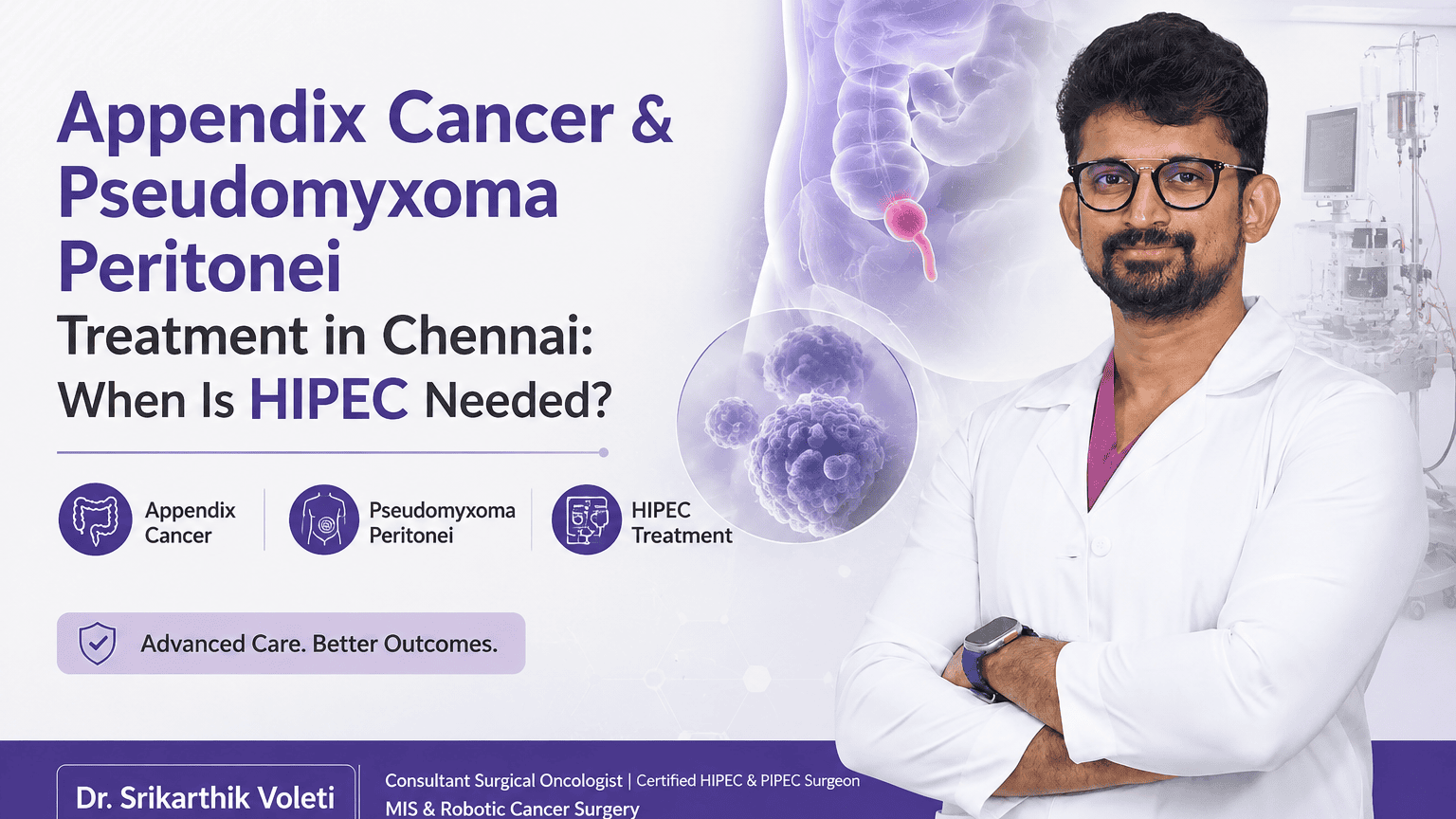
Appendix Cancer Treatment in Chennai: 7 Essential Facts About PMP & CRS-HIPEC
A clear patient-friendly guide to appendix cancer, pseudomyxoma peritonei, diagnosis, surgery, CRS-HIPEC and treatment planning.
Call for Consultation Get DirectionsAppendix Cancer Treatment in Chennai: A Complete Patient Guide
Appendix cancer is uncommon, and because of its rarity, patients and families may have questions about diagnosis, specialist care and treatment options.
Some appendiceal tumours can produce mucin, a jelly-like substance, which may spread within the abdomen and cause a condition called pseudomyxoma peritonei, or PMP.
If you are researching Appendix Cancer Treatment in Chennai, it is important to understand that treatment depends heavily on the tumour type, pathology and how far the disease has spread.
1. What Is Appendix Cancer?
Appendix cancer develops from cells in the appendix. Different types of appendiceal tumours can occur, including epithelial cancers and neuroendocrine tumours.
Some epithelial tumours can produce mucin. The exact tumour type is important because pathology can influence the treatment plan.
Because appendix cancer is rare, it may sometimes be discovered unexpectedly during surgery for appendicitis or after examination of an appendix specimen.
Why Does the Tumour Type Matter?
Appendiceal cancers do not all behave in the same way. Some can remain localized, while certain mucin-producing tumours can spread within the abdominal cavity.
For this reason, Appendix Cancer Treatment in Chennai should begin with an accurate understanding of the pathology and disease extent.
2. What Is Pseudomyxoma Peritonei?
Pseudomyxoma peritonei, commonly called PMP, occurs when mucin-producing tumour cells spread within the abdominal cavity and produce mucin.
Instead of behaving like a single lump that remains confined to the appendix, the disease can involve different surfaces within the abdomen. This can make treatment more complex.
Mucin Production
Some appendiceal tumours produce mucin, which can accumulate within the abdominal cavity.
Peritoneal Spread
Tumour cells can involve surfaces within the abdomen rather than remaining limited to the appendix.
Specialist Assessment
The distribution and nature of disease need to be evaluated before a treatment approach is selected.
Individual Treatment Planning
The treatment plan depends on pathology, disease extent and whether visible disease can be removed safely.
Is Pseudomyxoma Peritonei Cancer?
PMP is associated with mucin-producing appendiceal tumours and can range from relatively indolent disease to more aggressive disease.
Its treatment depends on the pathology and extent of spread. Patients should not assume that PMP has the same prognosis or treatment pathway as another abdominal cancer.
3. What Symptoms Can Appendix Cancer Cause?
Symptoms are not always specific. Some patients may have very few symptoms, while others may experience abdominal or digestive complaints.
Possible symptoms can include:
- Abdominal discomfort
- Abdominal swelling
- Changes in bowel habits
- Loss of appetite
- Unexplained weight changes
- Nausea or digestive symptoms
- A feeling of abdominal fullness
- Symptoms resembling appendicitis
Patients looking for Appendix Cancer Treatment in Chennai should understand that diagnosis comes before selecting surgery or other cancer treatment.
4. How Is Appendix Cancer Diagnosed?
Diagnosis may involve several investigations depending on the patient's symptoms, pathology and clinical history.
Imaging Scans
Imaging can help the medical team assess the abdomen and look for evidence of disease spread.
Blood Tests
Blood tests may form part of the overall diagnostic and preoperative assessment.
Colonoscopy
Colonoscopy may be considered in selected cases depending on the clinical situation.
Pathology Review
Biopsy or pathology review is important because the exact tumour type can influence treatment planning.
Why Is the Pathology Report Important?
The pathology report helps establish what type of tumour is present. This information can influence whether surgery alone, additional treatment or a more specialized peritoneal cancer approach should be considered.
A detailed review of pathology and imaging is therefore an important step in Appendix Cancer Treatment in Chennai.
5. What Is the Treatment for Appendix Cancer?
Treatment depends on several factors. These include the tumour type, tumour grade, whether the appendix has ruptured, the presence of peritoneal disease and the extent of abdominal involvement.
- Tumour type
- Tumour grade
- Whether the appendix has ruptured
- Presence of peritoneal disease
- Extent of abdominal involvement
- Whether complete tumour removal is possible
- Previous treatment
For some patients, surgery may be sufficient. For others with peritoneal spread, a more extensive treatment approach may be considered.
Can Appendix Cancer Be Treated With Surgery?
Surgery is an important component of treatment for many appendiceal cancers. The extent of surgery depends on the tumour and the pattern of spread.
For patients with extensive peritoneal disease, surgery may involve cytoreduction, sometimes combined with HIPEC.
When Is HIPEC Used for Appendix Cancer?
HIPEC can be used in selected appendiceal cancers. The treatment decision depends on the cancer type, pathology, distribution of disease and whether cytoreductive surgery is appropriate.
Cytoreductive Surgery → Removal of Visible Disease → HIPEC
Cytoreductive surgery aims to remove visible tumour deposits as safely as possible. HIPEC refers to heated chemotherapy delivered within the abdominal cavity as part of the planned treatment.
Not every appendix cancer patient requires HIPEC. A specialist assessment is necessary before considering this approach.
If you are specifically researching Appendix Cancer Treatment in Chennai involving PMP or CRS-HIPEC, bring your pathology and imaging reports to a specialist consultation for individualized assessment.
6. Appendix Cancer Treatment in Chennai: Choosing a Specialist
Because appendix cancer and pseudomyxoma peritonei are uncommon, patients may consider consulting a surgical oncologist experienced in complex abdominal and peritoneal cancers.
A specialist consultation can help explain the pathology, disease distribution, available treatment options and the possible role of CRS-HIPEC.
Questions to Ask Your Cancer Surgeon
- What type of appendix tumour do I have?
- Has the cancer spread into the peritoneum?
- Do I have pseudomyxoma peritonei?
- Is CRS-HIPEC appropriate for my situation?
- What are the goals of surgery?
- What alternatives are available?
- What additional tests are required?
- What should I expect during recovery?
Why Can a Second Opinion Be Useful?
A second opinion may help patients better understand a rare diagnosis, particularly when complex abdominal surgery or peritoneal treatment is being considered.
The purpose of a second opinion is to review the diagnosis and treatment options so that patients can make informed decisions with their medical team.
7. Appendix Cancer Treatment in Chennai: CRS-HIPEC and Treatment Planning
For selected patients with peritoneal disease, CRS-HIPEC may form part of a specialized treatment plan. The approach combines cytoreductive surgery with heated intraperitoneal chemotherapy.
Review the Diagnosis
Pathology is reviewed to understand the exact appendiceal tumour type and relevant disease characteristics.
Assess Disease Spread
Imaging and clinical assessment help determine whether disease involves the peritoneal cavity.
Consider Surgical Feasibility
The medical team assesses whether visible disease can be removed safely and what extent of surgery may be required.
Discuss Treatment Options
Patients can discuss surgery, CRS-HIPEC and other available treatment approaches according to their individual situation.
Appendix Cancer Treatment in Chennai should therefore be individualized rather than based on a single standard procedure for every patient.
Frequently Asked Questions About Appendix Cancer Treatment in Chennai
Yes. Compared with common cancers such as breast, lung or colorectal cancer, appendiceal cancers are uncommon.
Pseudomyxoma peritonei is a condition involving accumulation of mucin in the abdominal cavity, often originating from an appendiceal mucinous tumour.
No. HIPEC is not necessarily required for every PMP patient. It may be considered in selected cases after assessment of the tumour type, disease distribution and suitability for surgery.
Yes. Some appendiceal cancers, particularly mucinous tumours, can involve the peritoneal cavity.
Surgery is an important component of treatment for many appendiceal cancers. The extent of surgery depends on the tumour type and spread.
CRS stands for cytoreductive surgery, which aims to remove visible tumour deposits. HIPEC stands for hyperthermic intraperitoneal chemotherapy and involves heated chemotherapy delivered within the abdominal cavity as part of the planned treatment.
Patients should seek assessment from a specialist surgical oncology team experienced in complex abdominal cancers and peritoneal disease.
A second opinion can help patients understand a rare diagnosis, available treatment options and whether complex surgery or CRS-HIPEC should be considered.
Looking for Appendix Cancer Treatment in Chennai?
If you or a family member has been diagnosed with appendix cancer, a mucinous appendiceal tumour or pseudomyxoma peritonei, bring your pathology reports, scan reports and previous treatment records for specialist review.
A detailed consultation can help clarify the diagnosis, extent of disease and whether surgery, CRS-HIPEC or another treatment approach may be appropriate.
Call +91 98400 63699 Get DirectionsConclusion: Appendix Cancer Treatment in Chennai
Appendix cancer is uncommon and can present differently depending on the tumour type and extent of disease. Some mucin-producing appendiceal tumours can spread within the abdominal cavity and lead to pseudomyxoma peritonei.
Appendix Cancer Treatment in Chennai should therefore be based on accurate pathology, imaging and specialist assessment. Depending on the individual situation, treatment may involve surgery, systemic treatment, cytoreductive surgery, HIPEC or another approach.
For patients with peritoneal disease, understanding the role of CRS-HIPEC and discussing treatment goals with an experienced specialist can help clarify the available options.
Explore More Cancer Care Information
Learn more about HIPEC Treatment in Chennai and other specialized cancer treatment options available for selected patients.
For information about other gastrointestinal cancers, visit our guide to Colon Cancer Treatment in Chennai .